

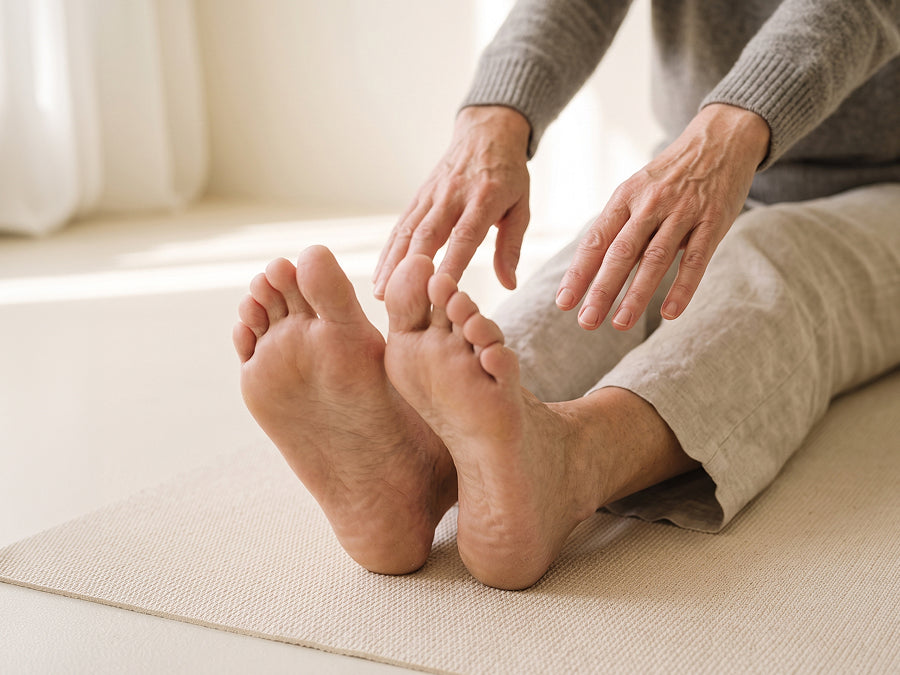
Understanding bunions: causes and impacts
Bunions. Those knobby nuisances that turn finding cute shoes into an Olympic feat. But beyond literally cramping your style, bunions, also known as Hallux Valgus in the medical world, can be a real pain in the... well, foot.
These bony bumps at the base of your big toe form when the joint gets misaligned. The research does not support the idea that bunions are inherited. What it does show is a strong association with specific foot types, particularly flat feet and hypermobile feet, where the joints allow more motion than usual. Women are especially prone to bunions because their joints and ligaments tend to be more flexible, allowing greater motion through the foot. That extra motion is what shifts the big toe joint out of alignment over time. If you have flat feet, the lack of arch support compounds the problem.
Here's the thing: bunions left unchecked can become real troublemakers, causing pain and inflammation, and making even comfy slippers feel like torture devices. The good news? Early intervention is your best friend. By taking charge early on, you can potentially prevent the pain and deterioration, and keep your feet happy.
This is where bunion exercises become your best friends. Specific exercises designed to strengthen your foot and realign things can make a big difference. Consulting a physical therapist can provide personalized foot exercises that target bunion pain and offer effective pain relief. These exercises are particularly beneficial depending on the different types of bunions you might be dealing with.
Essential exercises for bunion management
Here's your arsenal of bunion exercises and bunion stretches to mitigate pain and discomfort, and keep your feet feeling happy.
1. Toe (bunion) stretches
The goal: Improve flexibility and reduce tension
- Sit comfortably and gently pull your big toe upwards for 10 seconds, then push it down for another 10.
- Repeat these bunion stretches 10 times on each foot.
2. Toe circles
The goal: Improve mobility and circulation
- While seated, lift one foot and use your hand to make gentle circles with your big toe, 10 times clockwise and 10 times counter-clockwise.
- Repeat on the other foot.
3. Short foot exercise.
The goal: Build real strength in the muscles that hold your arch and control the big toe joint.
- Sit with your feet flat on the floor. Without curling your toes and without lifting your heel, draw the ball of your foot gently back toward your heel so the arch domes upward and the foot shortens slightly.
- Your toes stay long and relaxed the whole time. Hold for 5 to 10 seconds, then release.
- Repeat 10 times on each foot. Once it feels natural seated, do it standing.
- The distinction that matters: curling your toes with your grips, short foot lifts from your arch. Curling adds tightness to muscles that are usually already tight. Short foot builds the control needed to keep the big toe joint aligned.
4. Foot flexes
The goal: Improve flexibility and stretch under-foot muscles and tendons
- Sit with one leg extended, point your toes away for 5 seconds, then flex your foot back for another 5.
- Repeat 10-15 times on each foot.
5. Big toe abduction
The goal: Strengthen the one muscle that directly opposes the bunion deformity.
- Sit with your foot flat on the floor. Keeping your other four toes still and relaxed, slide your big toe away from them, out toward the midline of your body. Do not lift it, slide it along the floor. Hold for 5 seconds, then relax. Repeat 10 times on each foot.
- This is hard at first and most people cannot do it cleanly for the first week or two. That is the point. The muscle that pulls the big toe outward is the one that weakens as a bunion develops, and it is the one worth training. If your toe still won't move on its own, use your hand to guide it and keep trying to engage the muscle underneath.
6. Foot tripod
The goal: Learn where your weight should sit so it no longer loads the big toe joint.
- Stand barefoot with your feet hip-width apart. Find the three points that should share your weight: the base of the big toe, the base of the little toe, and the center of the heel. Press all three evenly into the floor without gripping or curling your toes. You should feel your arch lift slightly on its own. Hold for 20 to 30 seconds, release, and repeat 5 times.
- Most people with bunions collapse inward and load the inside edge of the foot, which drives the big toe further toward the second toe with every step. The tripod retains that.
7. Calf and Achilles stretch
The goal: Take pressure off the forefoot by restoring ankle mobility.
- Place your hands on a wall, step one foot back, and press that heel into the floor as you lean forward. Hold for 30 seconds. Then repeat with the back knee slightly bent, which shifts the stretch lower into the Achilles. Do both versions on each leg.
- A tight calf limits how far your ankle can bend, so your foot compensates by rolling inward and pushing more load through the big toe joint. Loosening the calf removes one of the forces driving the bunion forward.
8. Resistance band toe pulls
The goal: Strengthen and improve flexibility in the toes
- Wrap a resistance band around your toes and gently pull them apart, hold for 5 seconds, then release.
- Repeat 10-15 times on each foot.
9. Toe spreaders
The goal: Reduce pressure on bunions and improve toe flexibility
- Use toe spreaders or simply your fingers to gently spread your toes apart. Hold the position for 10 seconds.
- Repeat 10-15 times on each foot.
10. Arch lifts
The goal: Strengthen inner foot muscles, and improve stability and support
- Sit comfortably with your feet flat on the floor. Lift the arch of your foot while keeping your toes and heel on the ground. Hold for 5 seconds, then lower the arch back down.
- Repeat 10-15 times on each foot.
Remember, consistency is key. Aim to do these bunion exercises daily or a few times a week to see the best results in managing your bunions. Combining these exercises with techniques to shrink bunions naturally can provide comprehensive relief.
Integrating supportive tools in bunion care
Bunions caused by foot structure may be unavoidable, but Dr. Steven Gershman, DPM, tells us that "The speed of formation and severity of deformity can be affected and slowed." This means incorporating supportive tools into your daily routine can make a significant difference in managing bunions and them from worsening.
Here's how some key tools can become your allies in bunion care.
Supportive footwear
Dr. Gershman emphasizes the crucial role of proper footwear: "Shoes can and do affect the severity of the anatomical changes that occur in bunion formation".
He highlights the dangers of narrow, pointed-toe shoes and high heels, which force the big toe inwards and contribute to the deformity. Instead, opt for orthopedic shoes or shoes with wide-toe boxes that allow your toes to splay naturally. Specifically, consider investing in shoes for bunions, shoes for women with bunions, or men's shoes for bunions to ensure proper fit and support.
Orthotics provide targeted support to the foot, promoting proper alignment and reducing excessive motion that can exacerbate bunions.
Dr. Gershman recommends orthotics "designed to support the arch, control over pronation, align the foot, and correct the gait." He finds good over-the-counter orthotics very helpful for many patients. In severe cases, custom orthotics might be necessary.
While research is ongoing, "it is believed by many podiatrists that orthotics started early can significantly alter the severity of bunions and slow down the progression," says Dr. Gershman.
When selecting orthotics for bunion relief, consider the severity of your condition.
For severe bunions, prioritize orthotics with ample support and cushioning. Look for options with substantial arch support to distribute pressure evenly across your foot and metatarsal padding specifically designed to cushion the bunion area and reduce pain. Breathable materials are also key to prevent sweating and keep your feet comfortable throughout the day [1].
How to use bunion socks, and toe spacers
While not a preventative measure, bunion socks offer valuable relief, especially for those with mild bunions. These socks have a separator built-in, keeping the big toe from rubbing against other toes and reducing irritation. Look for comfortable, soft materials that wick away moisture.
Bunion pads are also helpful, offering a simple solution to protect the bony bump from friction and irritation caused by shoes or other objects. Dr. Gershman warns against medicated pads with acid, which can damage the skin. Opt for simple, protective pads instead.
Using a toe separator or toe spacer can aid in bunion correction by realigning the big toe joint, with combined toe stretches, which can significantly alleviate foot pain and prevent further bunion formation.
By incorporating these supportive tools into your routine, you can effectively manage bunion discomfort and potentially slow down their progression. Talk to your podiatrist to determine the best approach for your individual needs.
References
[1] Russell Pate, Pedorthist. Expert Advice: Picking The Right Orthotics For Bunion Relief. The Shoe Doctor. Accessed June 23, 2024. https://theshoedoctor.biz/expert-advice%3A-picking-the-right-orthotics-for-bunion-relief